Where we stand, and why this matters now
Women’s political participation in Africa is, by the headline numbers, in better shape now than at any prior point in the continent’s democratic history. Women held roughly 27 per cent of seats in Sub-Saharan African parliaments as of early 2025, which makes the region the strongest performer outside Europe and the Americas (UN Women, 2025). Namibia inaugurated its first woman president in 2024 and appointed its first woman Speaker the following year (IPU, 2026). The Maputo Protocol and the African Charter on Democracy, Elections and Governance commit African states to equality of participation and representation. Additionally, constitutional or statutory quotas supporting women’s participation have proliferated across the continent. Read together, these developments tell a story of slow but real progress towards more equitable governance on the continent.
The fuller picture presents a harsher reality, and it has sharpened in the past two electoral cycles. The Inter-Parliamentary Union’s 2026 review of political violence against parliamentarians found that 76 per cent of women parliamentarians surveyed reported experiencing public violence, online or offline, against 68 per cent of men (IPU, 2026). Behind these figures sits an everyday reality that practitioners working on recent African elections will recognise without need of citation: women candidates are driven out of races by gendered disinformation, threatened in their homes, sued into ruin, and quietly dropped from party lists when they decline to step aside. Where such conduct is unlawful on paper it is rarely punished in practice. Where it offends regional or international obligations the state has freely signed, the dispute-resolution machinery built to remedy it has, with rare exceptions, failed to deliver in time. Numerical inclusion has run ahead of substantive justice, and the gap between them is now the central electoral justice question facing African democracies. That gap is the subject of what follows.
Ask an electoral commission how many complaints it received from women candidates about threats, online abuse, or intimidation during the last election, and you will usually be met with a small number or a blank page. The temptation is to read that silence as the absence of harm. It is the opposite. The complaint a woman never files is not evidence that nothing happened to her. It is evidence that the system gave her no reason to believe filing would change anything, and several reasons to fear that it would cost her more than it returned. Violence against women in politics has become one of the central electoral justice questions of our time, and African dispute-resolution systems are, for the most part, not built to hear it.
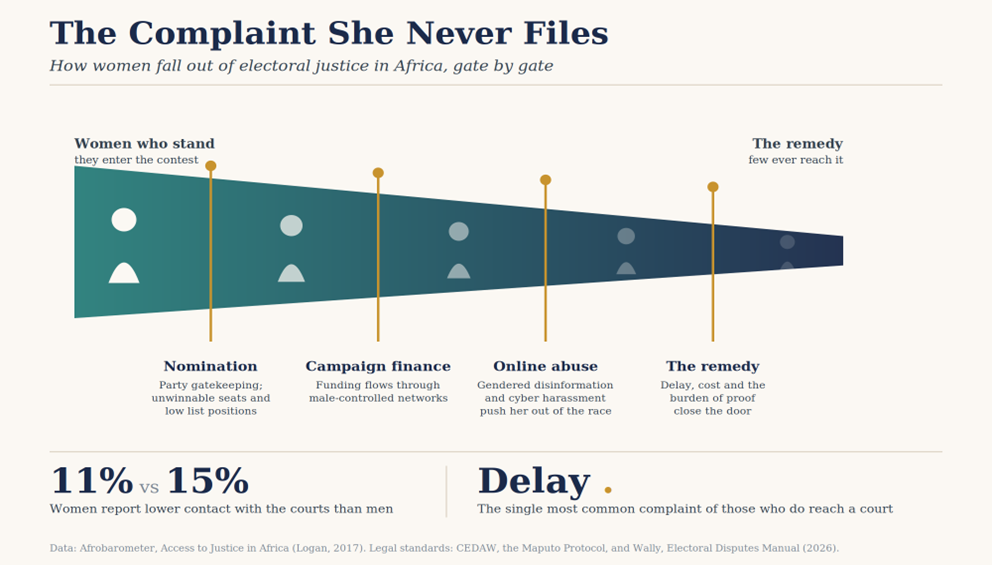
The error we keep making is to treat women’s access to electoral justice as a problem that begins on the night when elections are declared. It begins much earlier, and by the time a result is declared the exclusion is already complete. To see why, follow a woman’s path through an election and notice where the doors close.
The harm begins at nomination, not at the ballot
The first gate is the political party, and it is often the most exclusionary structure a woman encounters. Candidate nomination in many African parties remains an informal, male-dominated bargain in which women are placed in unwinnable seats, assigned the least favourable list positions, or asked to step aside for a male incumbent. The CEDAW Committee named this practice directly, warning that states must ensure women are not consistently assigned to less favourable constituencies or to the worst positions on a party list (CEDAW General Recommendation 23, in Wally, 2026). Campaign finance compounds the gate. Where nomination fees are high and party financing flows through male networks, women begin the contest with a structural deficit that no amount of personal merit erases. None of this is unlawful on its face, which is precisely why it rarely reaches a court.
The new battlefield is the phone in her hand
For a growing number of women candidates, the most damaging attacks now arrive online. Gendered disinformation, the deliberate circulation of false sexualised or domestic narratives designed to shame a woman out of public life, operates differently from ordinary political smear. It targets a candidate’s reputation as a woman rather than her record as a politician, and it travels faster than any correction. Cyber harassment and coordinated intimidation then push the harm offline, into the candidate’s home and family. African Commission guidance already instructs the media to refrain from perpetuating gender stereotypes and from spreading disinformation and hate speech, and to actively cover women candidates (Wally, 2026). The guidance exists. The enforcement does not. A woman driven out of a race by a campaign of online abuse has, in formal terms, withdrawn voluntarily. The record shows a free choice. The reality was a managed expulsion.
Why do the courts not catch her?
Even where a remedy formally exists, the path to it is gendered at every step. Afrobarometer’s continental survey found that women report lower rates of contact with the courts than men, eleven per cent against fifteen, and that long delay is the single most common complaint of those who do engage (Logan, 2017). For a woman candidate operating on a compressed electoral calendar, with less money and a shorter window before the harm becomes irreversible, delay is not an inconvenience; it is a denial. The evidentiary burden then finishes the exclusion. To prove harassment or a gendered campaign of intimidation, a complainant must document, preserve, and present evidence of conduct that is often anonymous, online, and designed to be deniable. The burden of proof, neutral on paper, falls hardest on the party with the least institutional support. This is why the IFES practitioner guidance on women’s access to electoral justice treats the accessibility of complaints systems, not merely their existence, as the real measure of whether a remedy is available (IFES, 2024).
The law already offers more than states deliver
The gap here is not primarily a gap in law. The Maputo Protocol commits African states to eliminate violence against women and to guarantee their participation in public life, and the African Commission has held that discrimination against women is particularly unjustifiable where it is used as a means of silencing them (Egyptian Initiative for Personal Rights & Interights v Egypt, 2011, in Wally, 2026). The CEDAW Committee has gone further and ordered remedy: in a case against Serbia, it found a violation of the Convention for failure to ensure women’s effective political participation and expressly recommended temporary special measures, including electoral quotas, to accelerate equality (Wally, 2026). Temporary special measures are not charity and not a departure from merit. CEDAW Article 4 classifies them as a legitimate tool of equality, and states may not excuse their absence by pointing to market or party forces beyond their control (CEDAW General Recommendation 25, in Wally, 2026). The SADC region’s own election principles call for such measures and for mechanisms to enforce them (Wally, 2026). The commitments are signed. The enforcement is optional. That is the scandal.
Intersection matters because exclusion compounds
None of this lands evenly. A young rural woman with a disability does not face one barrier at a time; she faces them simultaneously, and they multiply. Afrobarometer’s data shows that poorer, less educated, and rural citizens encounter far more problems with the courts than wealthier urban ones, and women already sit disproportionately in those categories (Logan, 2017). An electoral justice system that designs its complaints process around a literate, urban, connected complainant has, without saying so, designed out the women who need it most. Inclusion that stops at a national average is not inclusion.
What a system built to hear her would do
Three changes would begin to close the gap. First, complaint systems must be made physically and procedurally accessible to women, with confidential reporting channels, gender-aware adjudicators, and timelines short enough to matter inside an electoral cycle. Second, the evidentiary burden for online and gendered harms must be adapted to the nature of the harm, including duties on platforms and commissions to preserve and disclose the digital record a lone candidate cannot assemble. Third, temporary special measures must move from aspiration to enforced obligation, monitored and reported, with consequences for parties that ignore them. These are not radical demands. They are what the treaties African states have already ratified actually require.
The measure of electoral justice for women is not the elegance of the equality clause in the constitution. It is whether the woman who is threatened, defamed, and pushed out has somewhere to go that will act in time. Until she does, the complaint she never files will remain the most accurate statistic we have.
Dr Antonetta Hamandishe is EISA Tanzania’s Country Director and Ms Lenny Taabu is EISA’s Programme Officer in the Elections and Political Processes Department.
The authors are elections and governance practitioners and write in their personal capacity. This piece draws on discussions at the EISA Electoral Dispute Resolution Workshop held in Kenya in March 2026.
Sources
CEDAW Committee, General Recommendations 23 and 25; Convention on the Elimination of All Forms of Discrimination against Women (1979), Article 4.
Egyptian Initiative for Personal Rights & Interights v Egypt (African Commission on Human and Peoples’ Rights, 2011), as compiled in Wally (2026).
International Foundation for Electoral Systems (IFES). (2024). Electoral Justice for All: A Practitioner’s Guide to Increasing Women’s Access to Electoral Justice.
Logan, C. (2017). Ambitious SDG goal confronts challenging realities: Access to justice is still elusive for many Africans (Afrobarometer Policy Paper No. 39).
Protocol to the African Charter on Human and Peoples’ Rights on the Rights of Women in Africa (Maputo Protocol, 2003).
Serbia CEDAW individual communication, as compiled in Wally (2026).
Wally, M. (2026). Electoral Disputes Manual (First Draft; M. Hounkpé, Ed.).