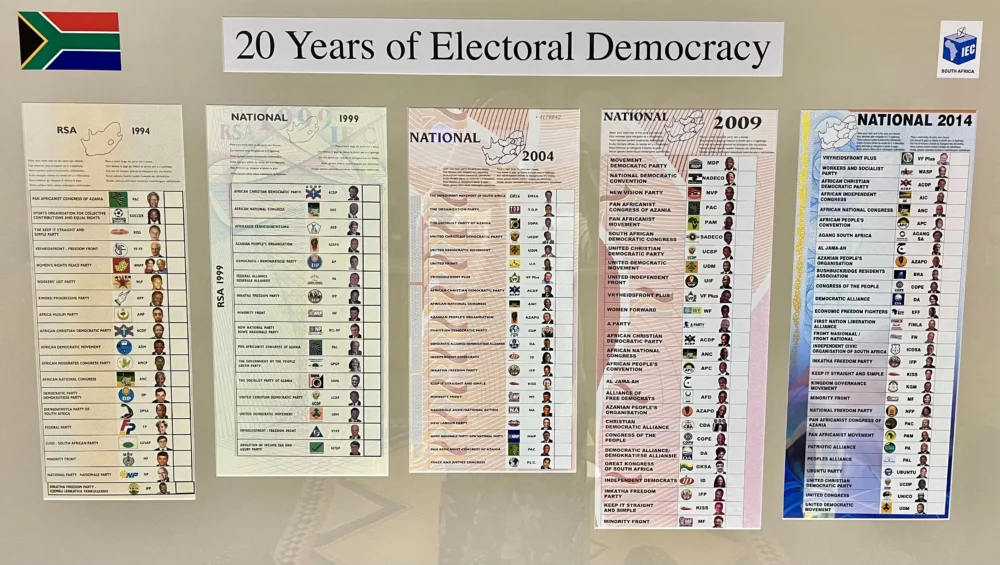
As South Africa prepares for what is set to be a competitive local Government Election (LGE) in 2026, the pervasive instability in municipal coalitions warrants urgent attention. Recent election result data indicates a rapidly fragmenting electorate. As the once hegemonic African National Congress (ANC) loses voters to opposition parties such as the Economic Freedom Fighters (EFF), Action SA (ASA) and uMkhonto weSizwe (MK) whereas as there are growing signs of the Democratic Alliance’s (DA) support fraying, the number of municipalities where no single party secures an absolute majority will surge.
While coalition governments have existed since the advent of democracy, particularly in KwaZulu-Natal and the Western Cape, the steep increase in the number of hung councils following the recent elections is most notable. Following the 2021 LGE, the Independent Electoral Commission (IEC) confirmed 66 hung councils, more than double the number from 2016. In Gauteng, eight of the nine municipalities were hung whereas in KwaZulu-Natal, twenty-one of the forty-four municipalities were hung. In the Western Cape, sixteen of the twenty-five local councils were hung. Consequently, in the aftermath of the 2021 Local Government Elections 88% of Gauteng municipalities were hung (44% in the previous election), 48% in KwaZulu-Natal (16% in the previous election) and 64% of municipalities in the Western Cape were hung (32% in the previous election). With the rise of parties including uMkhonto weSizwe (MKP), Action SA (ASA), Patriotic Alliance (PA), Rise Mzansi (RM) and the resurgence of established parties such as like the Inkatha Freedom Party (IFP), this fragmentation will likely expand into other provinces including Mpumalanga, the Free State and the North-West province.
The Consequences of Kingmaker Politics
South Africa’s proportional representation (PR) system was designed to foster consociationalism and inclusivity. However, this system has unintentionally empowered parties with smaller support bases to act as kingmakers, potentially giving them disproportional power. One of main consequence is that, when smaller political parties pull out of the coalition arrangement, they can force motions of no confidence that collapse the incumbent government. This ‘musical chairs’ dynamic has been witnessed in major metropolitan municipalities including the City of Johannesburg, City of Tshwane and Nelson Mandela Bay, where abrupt shifts in allegiance have resulted in a revolving door of mayors.
Nelson Mandela Bay itself is a good case in point, the National Alliance (NA), a party of three councilors, has switched allegiance on various occasions, resulting in four mayors in three years, including a 17-month stint for the leader of the NA. A similar dynamic has played out in important Gauteng metropolitan municipalities. This instability distracts elected leaders from critical service delivery, forcing them to prioritise political survival instead of public welfare.
Possible Remedies: Balancing Stability and Democratic Will
Mitigating this instability requires pragmatic legislative reforms that do not over-police the political environment or infringe upon the voters’ democratic will. A possible solution is to introduce a formal electoral threshold. This would require parties to receive a minimum percentage of votes (for example 2%) to be allowed to gain representation in council. This would mitigate against the extreme fragmentation that allows smaller parties to auction off votes and subsequently collapse coalitions. While Parliament should play its part in ensuring that such reforms do not infringe upon constitutional principles, appropriate electoral thresholds would discourage the commodification of local government seats while preserving diverse political voices.
Another proposed solution would be to overhaul the electoral system in its entirely and replace it with one that ultimately yields a governing majority. Proponents of this approach argue for a shift to a pure First Past the Post (FPTP) system. This would mean that all councilors would be elected as ward representatives and party list councilors would cease to exist. Smaller parties, which typically gain representation via the party list, would be eliminated in their entirety unless they command concentrated support within a ward. An advantage of this is that wards would be smaller (since the number of ward councilors would double). This means that individual councilors would, on balance, be more responsive to resident’s as they cater to a smaller number of residents. However, a significant disadvantage is that smaller, special interest or minority parties would find it harder to gain representation, potentially going against the ethos of democratic consolidation, and possibly, Section 46(1)(d) of the Constitution.
There are also critical discussions around the Local Government Municipal Structures Amendment Bill. Introduced by COGTA, this bill seeks to institutionalise coalition governance by compelling parties to enter legally binding and transparent coalition contracts. Secondly, the bill also includes ensuring that elections in councils and removal of governments be transparent and be by a show of hands, thus eradicating secret ballots. While these are necessary safeguards, lawmakers must exercise caution. This article cautions against over-policing the political arena which may lead to the systematic deferral of political disputes to the courts. The ultimate goal ought to be that of ensuring that elected governments truly reflect the people’s will.
As South African society continues to mature and new challenges emerge, our political frameworks must evolve. The mandate of stabilising coalition governments must be high on the 2026 post-election agenda, as the continuous disruption of local government threatens to further erode the fragile social contract. While every proposed solution carries a double-edged sword, of both positive and negative repercussions, the viability of these reforms must be weighed against the moral and democratic obligation to uphold the will of the people.
Thembelani Mazibuko is an independent Election Expert.
Noxolo Gwala is an International Programme Officer at the Electoral Institute for Sustainable Democracy in Africa.