Introduction
In his interview at the Ciné Droit Libre festival, Théophile Obenga, one of Africa’s leading intellectuals and a key disciple of Cheikh Anta Diop, describes democracy as a “mission” carried out on behalf of the people – a political mandate whose primary goal is to serve the public interest. In Chad, recent constitutional and electoral reforms have followed one another at a rapid pace, yet for many citizens they remain highly technical processes, poorly explained and largely driven from the top down. It is precisely this democratic blind spot that the Coalition pour les Réformes au Tchad (CRET), with technical support from EISA, seeks to address through its Forums and Citizens’ Cafés: creating spaces where discussions about the rules of the political game are no longer reserved for experts and political elites, but become debates in which citizens can participate in an informed way.
Technical reforms that reshape power
In Chad, the so called “technical” revision of the 2023 Constitution illustrates the gap between democratic rhetoric and political practice. On 5 September 2025, the National Assembly set up a special commission of around 25 members to examine amendment proposals submitted by the government and MPs, before adopting its final report. The reform extends the presidential term from 5 to 7 years and removes term limits, lengthens the mandate of members of parliament from 5 to 6 years, allows the president to combine the roles of head of state and party leader, and introduces institutional adjustments such as a vice prime minister and public funding for election campaigns.
From an institutional engineering perspective, the official argument for longer, harmonized mandates is that they can reduce the frequency of national polls, smooth electoral costs and provide a more stable time frame for planning and evaluating public policies. In a dominant party context, allowing the head of state to lead the ruling party can also clarify the political chain of command and limit blockages between the executive and the parliamentary majority. However, taken together, a renewable 7 year presidential term with no limit on the number of mandates and this dual role significantly strengthens presidential power and reshapes the structural balance between the executive and the legislature. Upcoming elections will therefore take place in a framework where the incumbent benefits from a longer time horizon, increased influence over parliament and broader institutional room for maneuver – a configuration that Human Rights Watch (HRW, October 16, 2025) warns could weaken prospects for alternation and genuine political competition.
The single ballot: procedural improvement, new challenges
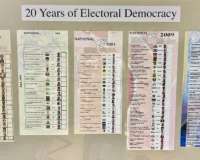
On the electoral side, Ordinance No. 007/PR/2024, ratified by the National Assembly on 3 December 2025, amends Article 51 of the Electoral Code to extend the use of a single ballot paper to presidential, legislative and local elections, while maintaining two separate ballots for referendums. For legislative, senatorial and local contests, each party or party coalition is now represented on this single ballot by its emblem and/or the names of its candidates, with the order of appearance determined by lot.
Operationally, this harmonization reduces the number of ballot formats, simplifies printing and distribution logistics and lowers certain risks, such as wrong or missing ballots. It also limits the opportunities for ballot stuffing or targeted substitution in favour of a specific party. The single ballot can also improve visual identification of choices through party symbols – crucial in a context of low literacy – provided that the layout is clear and user friendly. At the same time, it imposes demanding conditions: careful graphic design to avoid confusion, voter education so that people can correctly locate their preferred party or candidate. Ballot design also requires rigorous quality control, since any mistake in logos or names would affect the entire country. Symbolic competition on one sheet can also disadvantage smaller or less visible parties if the layout does not guarantee genuinely equal visibility, despite random ordering.
Operationally, this harmonization reduces the number of ballot formats, simplifies printing and distribution logistics and lowers certain risks, such as wrong or missing ballots, while limiting opportunities for ballot stuffing or targeted substitution in favour of a specific party. The single ballot can also improve visual identification of choices through party symbols – crucial in a context of low literacy – provided that the layout is clear and user friendly. At the same time, it imposes demanding conditions: careful graphic design to avoid confusion, voter education so that people can correctly locate their preferred party or candidate, and rigorous quality control, since any mistake in logos or names would affect the entire country. Symbolic competition on one sheet can also disadvantage smaller or less visible parties if the layout does not guarantee genuinely equal visibility, despite random ordering.
Beyond arguments for or against them, the differing reception of recent constitutional and electoral reforms by political actors and citizens raises the fundamental question of what makes an electoral reform relevant.
Who defines the “relevance” of reforms?

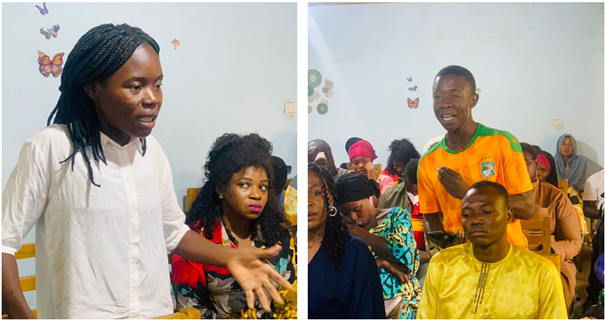
Electoral reforms are often captured by partisan interests rather than guided by the common good. This dynamic emerged very clearly during CRET’s Citizens’ Cafés: people living with disabilities legitimately demanded better recognition of their rights; women called for greater representation in elected bodies; young people stressed the need for fairer access to elected office and to the labour market. Each group articulated expectations rooted in its own lived experience and priorities.
Like citizens, political parties view electoral reforms through the lens of their strategic interests. The recent cross party rejection of proposals to open up electoral competition to non partisan candidates is telling: beyond ideological divides, no political actor was keen to see organised civil society compete directly with them. This convergence underlines the fact that constitutional and electoral reforms are far from neutral. They are drafted and adopted by actors who are themselves directly affected by the outcome of future elections. International research on electoral law reform emphasises that such changes are rarely free from electoral calculations, precisely because they can shape who wins and who loses.
Yet an electoral reform cannot claim to be democratic if it is reduced to a sum of sectoral demands or partisan bargains. To be democratically “relevant”, a reform must, as Obenga suggests, aim at the general interest: rules that are fair, inclusive and broadly accepted, capable of strengthening citizens’ trust and the legitimacy of institutions.
Bringing people back to the centre of the debate
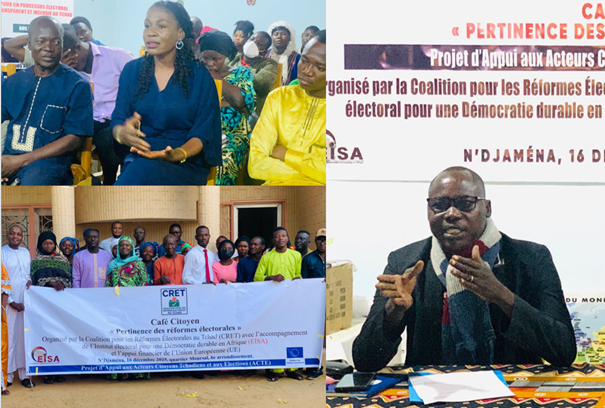
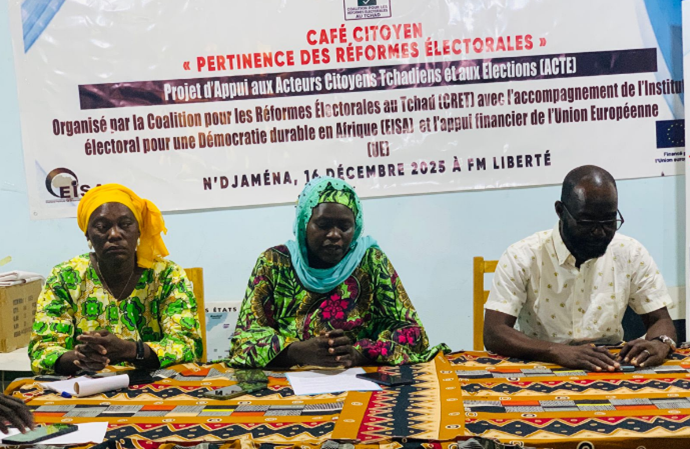
This is where CRET’s Forums and Citizens’ Cafés come in. They create spaces where reforms are no longer debated only by experts, parties and institutions, but are confronted with the direct voices of citizens. By opening up discussions on the subject of marginalised people, women’s representation or the transparency of the electoral process, these initiatives help to re anchor reforms in a logic of popular sovereignty rather than in strategies of power management.
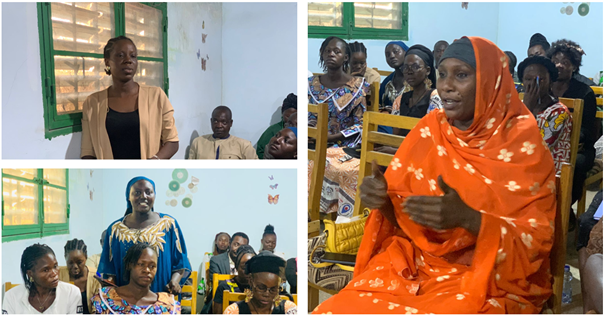
This approach also sheds light on the gap between the reform agenda and everyday experience. During the Citizens’ Café held on 16 December 2025 with women participants, a deep sense of weariness emerged. Several women questioned the meaning of electoral reforms that have been repeated since the introduction of political pluralism without ever producing lasting trust. One suggested measuring this trust on a scale from 1 to 10, noting that for many people the word “election” now evokes frustration more than hope. Others challenged the relevance of new legal revisions if existing texts are not effectively implemented. These contributions highlight a persistent disconnect between reforms decided “from above” and the lived realities of citizens.
In light of Obenga’s call to ground reforms in the pursuit of the common good, a reform is truly “relevant” only if it brings political practice closer to the idea of democracy as a mission. The central question then becomes whether the changes underway move power towards or away from its primary purpose: serving the interests of the people and responding to their expectations.
Pierre Sossou is the Country Director for EISA’s Chad office.
This blog post was made possible thanks to financial support from the European Union under grant agreement No. NDICI AFRICA/2022/435-927. The opinions expressed here are those of the authors and do not necessarily reflect the views of the EU.