One of the most significant discussion points that might follow the 2026/27 Local Government Elections may revolve less around which party secured the most votes and more around why large numbers of voters chose not to turn up at the polls.
Both the previous 2021 Local Government Elections and the 2024 National and Provincial Elections experienced notable declines in voter turnout. In the 2024 National and Provincial Elections, turnout decreased by 7.35%, reaching a historic low of 58% (IEC, 2024). In the 2021 Local Government Elections, turnout dropped by 12.08%, falling to 45% (IEC, 2021). While voter turnout does naturally fluctuate from one election to another, the emerging pattern suggests a more concerning trend: citizens appear increasingly disengaged from the formal political process.
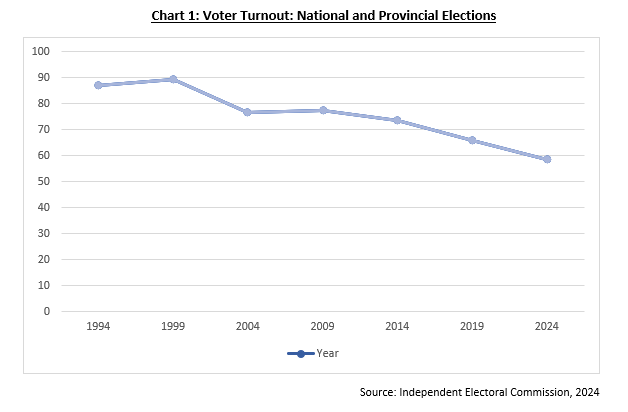
The 1994 General Election recorded an 86% voter turnout, which was to be expected given that it was the first opportunity most South Africans had to vote. In 1999, turnout further increased to 89% before declining to 76.7% in 2004 (Election Resources, 2004). Twenty years later, turnout in the 2024 General Elections stood at 58.64%, representing a roughly 30% decrease compared with the elections held in the 1990s.
Because the 1994 election was organised under severe time constraints, many citizens did not have the opportunity to register beforehand, and turnout was therefore calculated as a proportion of the entire voting age population rather than registered voters. This makes the decline in turnout in subsequent elections even more stark, as turnout since 1999 reflects the behaviour of individuals who actively registered to vote. The downward trend depicted graphically below:
Local Government Elections in South Africa have consistently seen lower turnout than General Elections. Turnout in the first three local elections (1995, 2000, and 2006) was approximately 48%, increased slightly in the next two elections, and then fell sharply to 45% in 2021 (IEC, 2021). As such, one in eight fewer people voted in 2021 compared with 2016, the drop between the two election cycles is depicted in the graph below.

When viewed together, turnout in both General and Local Government Elections reveals a troubling trajectory. The more than 10% decline in turnout in the 2021 Local Government Elections indicates growing public disengagement. Further to this, an Afrobarometer survey found that 70% of South Africans were “dissatisfied” with the functioning of democracy (Afrobarometer, 2025). Another Afrobarometer survey in 2024 showed that only 25% of respondents were “fairly/very satisfied” with democracy, marking a steep decline from 60% in 2011 (Afrobarometer, 2026).
Particularly concerning is that only 35% of South Africans prefer a democratic form of government – a measure Afrobarometer refers to as “demand for democracy”. Surprisingly, this places South Africa in the bottom third of African countries on this measure, with the continental average standing at 43% (Afrobarometer, 2024).
When interpreted together, both the voter turnout figures and the Afrobarometer findings suggest a worrying turnout outlook for the forthcoming Local Government Elections.
Measures to Increase Voter Turnout
A number of interventions may help to increase voter participation:
1. Ongoing Voter Registration Weekends
The IEC could consider hosting multiple physical voter registration weekends. At present, only two such weekends take place in the run up to an election. Regular registration opportunities (beginning once voting stations have been confirmed) may help ensure that even less engaged voters eventually register.
2. Using Technology
In 2021, the IEC introduced online voter registration, allowing citizens to register via computer at any time. This reform significantly improves accessibility, particularly for first time voters and those who have moved and subsequently need to re register (Legal Defense Fund, 2020).
3. Same Day Voter Registration
Same day voter registration allows unregistered citizens to register and vote on election day. Proponents argue that this increases accessibility and voter participation particularly among transient populations including college students as well as people who have just moved (IRG 2023). Critics argue that it can create logistical challenges, particularly with estimating voter numbers and preparing adequate resources whereas it is also argued that the policy opens the door to duplicate voting (AFPI, 2024). Although promising, it may be better suited to General Elections than Local Government Elections.
4. Automatic or Compulsory Voter Registration
Under this system, citizens are automatically registered when they turn 18. The leader of the Economic Freedom Fighters, Julius Malema has recently expressed support for automatic registration, claiming it would increase youth participation (Nozulela, 2026). Several European countries, including Germany, Sweden, Denmark, Finland, Norway, and France, already use automatic voter registration (James, 2025).
In Conclusion
Voters may stay away from the polls for a range of reasons. Chief among these is widespread dissatisfaction with democracy, as indicated in the Afrobarometer surveys. For some individuals, protest action may have overtaken elections as their primary mode of political expression. No reform is likely to persuade this group to vote.
Nonetheless, there remains a set of practical measures that could improve participation for those who do wish to vote. Transplanting policies across countries must be approached with caution, as electoral systems differ significantly. However, some reforms could be adapted to the South African context, ensuring that citizens are able to exercise their democratic rights without undue obstacles.
Ultimately, the state carries a responsibility to ensure that the franchise is as universal and as accessible as possible. Given South Africa’s history, protecting and expanding access to the vote must remain a national priority.
Thembelani Mazibuko is a senior researcher at the Electoral Institute for Sustainable Democracy in Africa.
References
Afrobarometer (2024) South Africa. https://www.afrobarometer.org/wp-content/uploads/2024/06/South-Africa-Democracy-scorecard-Afrobarometer-6june24.pdf
Afrobarometer (2025) Minorities of South Africans support democracy, oppose military rule. https://www.afrobarometer.org/wp-content/uploads/2025/10/News-release_Minorities-of-South-Africans-support-democracy-oppose-military-rule_Afrobarometer_21Oct25-1.pdf
Election Resources (2004). April 14, 2004 General Election Results – Republic of South Africa Totals: National Assembly. http://electionresources.org/za/provinces.php?election=2004&province=ZA
IEC. (2021) Voter Turnout. https://results.elections.org.za/home/LGEPublicReports/1091/Voter%20Turnout/National.pdf
IEC. (2024) Voter Turnout. https://results.elections.org.za/home/NPEPublicReports/1334/National%20Ballot/Voter%20Turnout/National.pdf
IRG. (2023) How Same-Day Voter Registration Reduces Election Litigation. https://responsivegov.org/research/how-same-day-voter-registration-reduces-election-litigation/
James, T (2025, July 18) Automatic Voter Registration: A Huge Step Forward for Democracy – and a Chance to Bring Missing Millions into Elections. The Conversation. https://theconversation.com/automatic-voter-registration-a-huge-step-forward-for-democracy-and-a-chance-to-bring-missing-millions-into-elections-261489
LDF. (2020) Online Voter Registration: Good for States, Good for Voters. https://www.naacpldf.org/naacp-publications/ldf-blog/online-voter-registration-good-for-states-good-for-voters/
Nozulela, M (2026) Malema calls for automatic voter registration for every 18-year-old in SA. Independent Online. https://iol.co.za/news/politics/2026-02-01-malema-calls-for-automatic-voter-registration-for-every-18-year-old-in-sa/